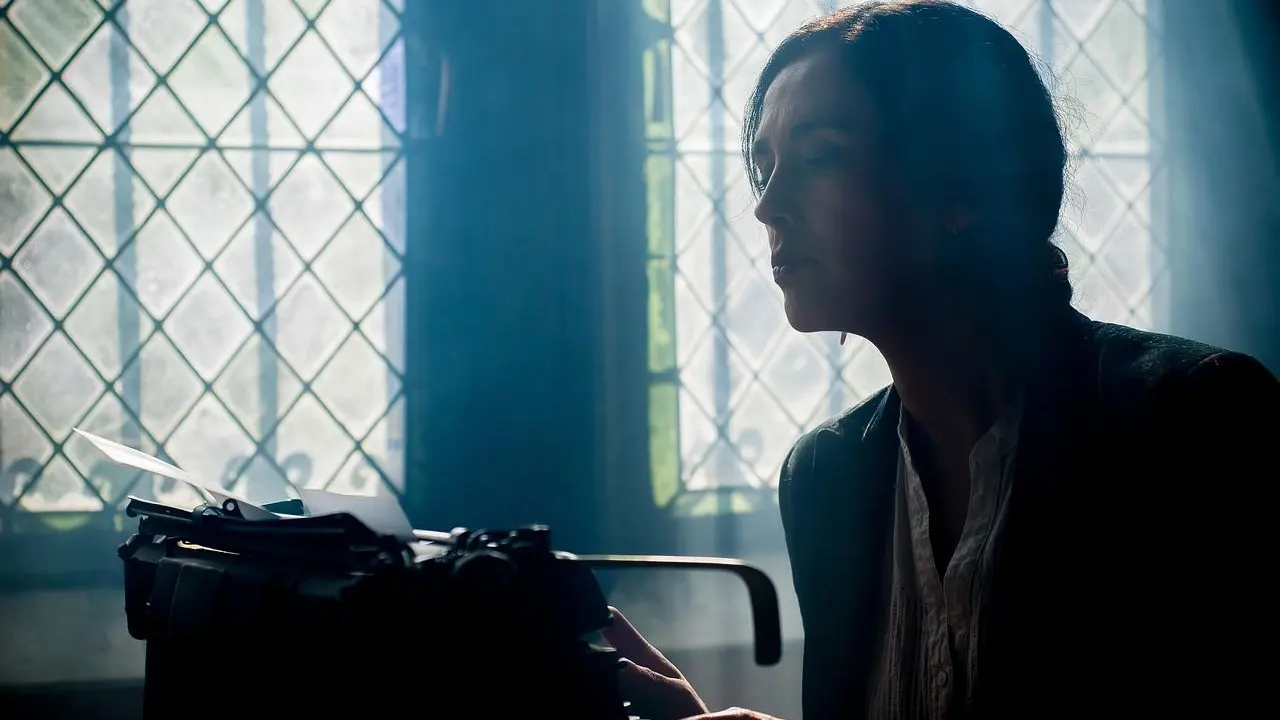
Told to “show, don’t tell” but unsure what that looks like? These show don’t tell examples put a flat statement beside a scene. Swap the label for a detail, an action or a line of dialogue.
This page is part of a wider set of writing and language basics for readers who want the bigger picture.
| Item | Value |
|---|---|
| Year of Chekhov’s letter behind the famous quote | 1886 |
| Length of Ulysses, a warning about showing everything | Around 800 pages |
| When to show | Pivotal scenes and moments of conflict, drama or crisis |
| When to tell | Linking dramatic scenes and skipping a quiet stretch of time |
| Cost of showing | A longer text with denser meaning |
The figures above come from Scribophile and The Write Practice. Sources can change their pages, so check them before you rely on the numbers.
What show, don’t tell actually means
Reedsy describes show, don’t tell as a technique in which story and characters come through sensory details and actions rather than exposition. Its shorthand is short: showing illustrates, while telling merely states. You can read the full explanation in Reedsy’s guide.
The rule usually travels with a line attributed to Anton Chekhov: “Don’t tell me the moon is shining. Show me the glint of light on broken glass.” That wording is quoted on the same Reedsy page.
Scribophile points out that this maxim is a condensed idea from a letter Chekhov wrote to his brother in 1886. In the original he urged writers to “seize on small details, grouping them so that when the reader closes his eyes he gets a picture.” The takeaway on Scribophile is the same as the slogan: small, specific details lead a reader into your world.
ProWritingAid adds a useful note on vocabulary. Other words for telling include exposition and narrative summary, which explains why the advice often appears in editors’ margins as “too much summary”.
Show don’t tell examples: before and after
Each pair below keeps the information the same and changes only how the reader receives it. They are original rewrites in the spirit of the pairs teachers use, such as the one on Writing Forward, where “Kate was tired.” becomes Kate rubbing her eyes and willing herself to keep them open.
A feeling
Telling: Priya was nervous before the interview.
Showing: Priya read the same line of her notes again. Her knee bounced under the table, and she wiped her palms on her trousers before the door opened.
A character trait
Telling: Dan was generous.
Showing: When Dan noticed Mia had skipped lunch again, he slid his sandwich across the desk and said he wasn’t hungry anyway.
A setting
Telling: The kitchen was a mess.
Showing: Dishes leaned in the sink in a slow tower, and the bin lid wouldn’t close over the pizza boxes. A fly circled the open milk carton on the counter.
Scribophile makes the same move with temperature: saying a room was cold is telling, while mentioning frost on a windowpane or thick socks shows the cold without saying it.
A tense moment between people
Telling: They were angry with each other after the argument.
Showing: “Fine,” she said, and set his keys down without looking at him. He waited for her to say more, then picked them up and left the door open behind him.
What changed in every pair
- A concrete detail replaced a label such as nervous, generous or messy.
- An action or a line of speech stood in for the stated feeling.
- The reader drew the conclusion instead of being handed it.
How to turn a told line into a shown scene
Start by spotting the label, the word that names a quality without evidence. The Write Practice calls the simplest rule be specific: write specific details, and they fill the gaps left by your telling. Its full explanation is on The Write Practice.

- Underline the label word in your draft, such as angry, messy or brave.
- Ask what a camera would see, or a microphone hear, if that label were true.
- Choose the detail or action that points to it most directly and write that in its place.
- Let a choice, a line of dialogue or a bit of body language do the work, then cut the sentence that explains it.
- Reread and trim any detail that does not earn its place.
Scribophile lists setting, dialogue, specificity, the active voice and avoiding filtering words among its ways to show, in its contents list. If you want to tighten the verbs in your shown lines, our explainer on active vs passive voice is here: active vs passive voice.
When telling is the better choice
Showing costs space. The Write Practice notes that once you get specific, your story can get a lot longer. ProWritingAid makes the trade explicit: the technique will increase your word count, but it also greatly increases the density of meaning in your story.
Scribophile warns that showing every single moment ends in a sprawling epic told in real time, and it points to James Joyce’s Ulysses, which runs around 800 pages. Its advice is to pick pivotal moments and use telling to string them together, as set out on Scribophile.
The Write Practice gives a quick guide to the choice:
- Show a pivotal scene, such as the climactic moment in your story.
- Show a moment of great conflict, drama or crisis.
- Tell when you are linking dramatic scenes and need to skip a less dramatic period of time.
- Tell when you are giving information the reader needs that does not advance the plot.
Jericho Writers puts the balance plainly: virtually every novel ever written contains passages that are told, not shown, and that is fine. It also describes showing as a slower, richer, more expansive way to communicate, which is why you spend it where it counts.
If you are drafting fiction at short length, spending your showing on a few pivotal moments is a sensible habit. Our guide on how to write a short story is a good next read.
Keep showing from turning into padding
Detail is only useful when it carries meaning. The Write Practice says you should want to be more specific, but you’ll need to cut the detail that doesn’t add to your story.
A fast self-edit pass can help you decide what stays:
- Does the detail reveal a feeling, a trait or a relationship, or is it only decoration?
- Would a reader reach the same conclusion without the extra sentence?
- Is this a pivotal moment, or a bridge that a single told line could cross?
For practice, write a handful of told sentences about a person, a place and a mood. Then rewrite each as a short scene, and compare how much the reader has to work out for themselves.
Frequently asked questions
What is the difference between showing and telling?
Show answer
Telling states a fact, such as “Michael was terribly afraid of the dark.” Showing puts the reader inside the experience through actions and sensory detail, as described in Reedsy’s guide.
Is telling always wrong?
Show answer
No. Jericho Writers notes that virtually every novel ever written contains told passages. Telling suits background information and transitions between big scenes.
Does showing make writing longer?
Show answer
Usually, yes. Specific detail takes space, so reserve it for pivotal moments, a point made by The Write Practice.
Did Chekhov really say “show, don’t tell”?
Show answer
Not in those words. According to Scribophile, the famous line condenses a letter he wrote to his brother in 1886 about describing nature through small details.